 Roari Solutions
- 14 Modules
- Switched On One at a Time, Sharing One Ledger, and Growing With Your Workforce
- 104 Ready-Made Reports
- Trial Balances, Payroll Costs, Stock Ageing, Sales Pipelines, and Much More
- 401 Permissions
- Assigned Role by Role, Checked for Conflicts, and Applied to Every API Key
- 38 Import Templates
- Validated Before Saving, Loaded All at Once, and Ready on Day One
- 77 Live KPIs
- Tracked Across Every Module, With Alerts When a Number Crosses the Line
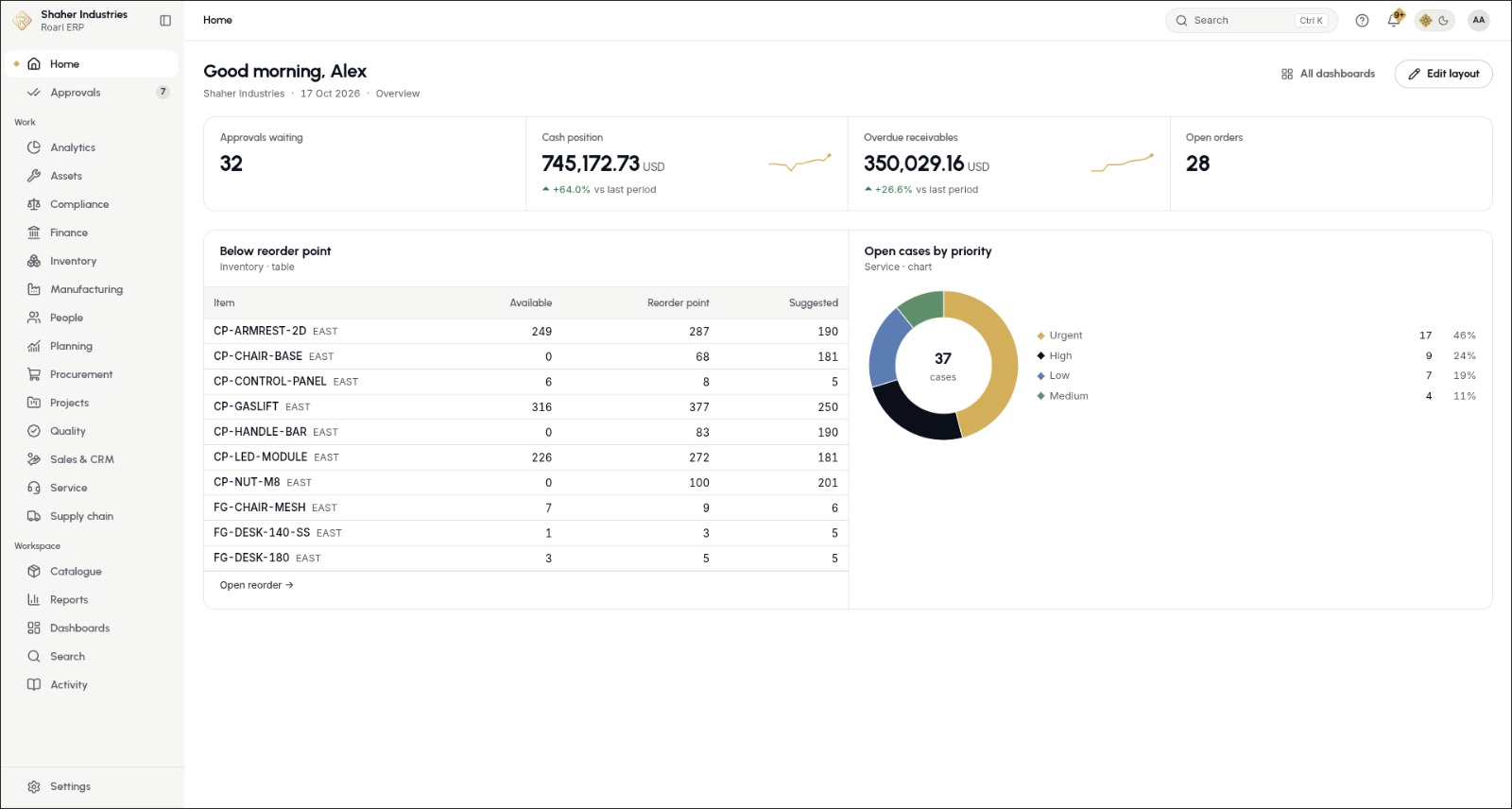
One system, fourteen modules, no ceiling: inside Roari ERP
Ask a finance director at a growing company how many systems it takes to close the month, and you'll usually get a number followed by a sigh. Payroll lives in one tool, stock in another, and the CRM never quite agrees with the invoices. Someone spends the last week of every month copying numbers between them.
We built Roari ERP to make that week disappear.
Fourteen modules, one ledger
Every module writes to the same books. A shipment, a payslip or a depreciation run lands in the general ledger the moment it happens, with nothing to re-key or reconcile later.
Finance & accounting: multiple entities and currencies, bank reconciliation, revenue recognition, consolidation, and a close board that shows what's still blocking month-end.
Inventory & warehousing: every lot and serial number tracked to the bin, scheduled stock counts, and reorders before you run out.
Procurement: requisitions, competing vendor quotes, and three-way matching, so nobody pays for goods that never arrived.
Sales & CRM: first lead to final invoice, with credit limits enforced before the order ships, not after.
Manufacturing: multi-level bills of materials, MRP, a drag-and-drop production schedule, and a big-button shop-floor terminal.
Supply chain: demand forecasts from your own shipment history, transfers planned between warehouses, and partners screened before you trade.
Projects: timesheets, expenses, milestone billing and profitability in one view per project.
HR & payroll: recruitment to payslips, plus leave, reviews, training and self-service for every employee.
Customer & field service: SLA clocks on every case and a dispatch board for technicians.
Asset management: preventive maintenance, fleet tracking, and a map of everything you own.
Quality: inspections, corrective actions, and control charts that flag a drifting process early.
Governance, risk & compliance: segregation-of-duties conflicts caught before a role is assigned, and a live risk register.
Planning: driver-based budgets, what-if scenarios, and a rolling forecast that updates with actuals.
Analytics: a report builder, dashboards, and alerts when a KPI crosses a line.
Finance is the only required module. Switch the rest on as the business needs them; if one depends on another, the system turns that one on too and tells you why.
Onboarding is one form
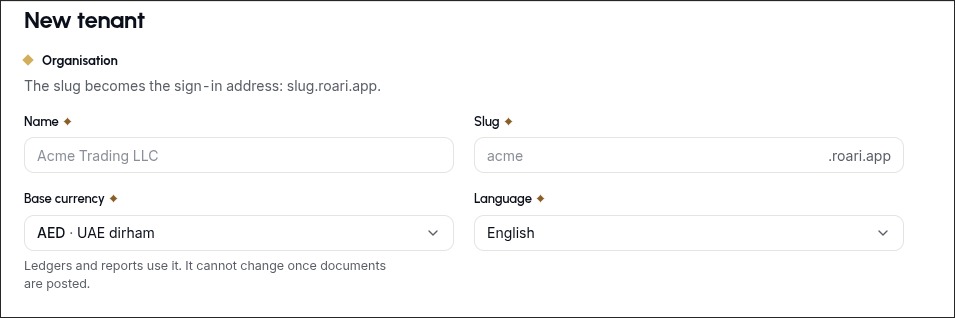
A new organisation needs a name, a web address, a base currency, a language (English or Arabic, fully right-to-left) and a first administrator. Pick the modules and the workspace is ready.
Existing data arrives through ready-made spreadsheet templates. Each file is checked before anything is saved, with every problem pointed out by row and column, and an import goes in whole or not at all. A built-in guide opens from every screen, so new staff learn on the job, not in a training room.
Plugging in what you already run
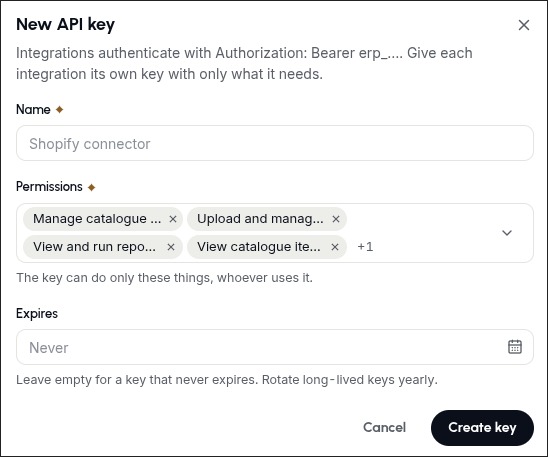
Integrations connect through API keys, and each key is made for exactly one job. When an administrator creates a key for, say, your online store, they choose its permissions one by one. The key can do those things and nothing else; it can never create other keys or change passwords.
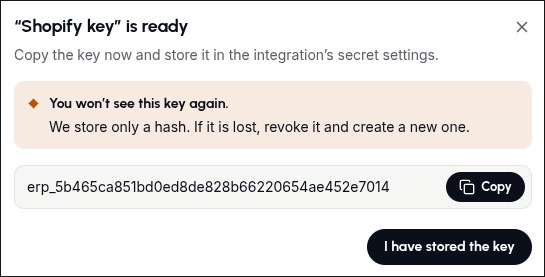
The full key is shown once, then stored only as a hash. Your integration sends it as a bearer token in the Authorization header. Keys can expire on a set date, show when they were last used, and can be revoked in one click. Everything a key changes is written to the audit trail, just like a person's actions. Webhooks push events out as they happen, and a data export feed keeps your warehouse in step.
Your servers, your data
Run Roari ERP with us, or on your own infrastructure. Self-hosting is a single release package installed on your server, with each organisation on its own address. Backups run nightly, and every upgrade checks the system's health afterwards, rolling itself back if something isn't right. For companies whose data can't leave the building, that settles it.
Where that leaves you
One login, one set of books, and a system that adds modules as your headcount grows. If month-end still takes a week, let's talk.