 Roari Solutions
- 4 Planning Levels
- Projects, Epics, Sprints, and Tasks, Each With Its Own Properties and Rich-Text Body
- 10 Ready-Made Properties
- Estimation, Urgency, Complexity, and More, All Editable From Day One
- 3 Project Roles
- Viewers Follow Along, Members Claim Their Own Work, and Owners Control the Money
- 7 Payment States
- Tracked From Upcoming to Paid, With Partial Receipts and Multi-Currency Display
- 95 API Endpoints
- Generated From SQL, Checked Against Every Role, and Served From One Container
- 0 Seat Fees
- Unlimited Members, Clients, and Contractors, With No Feature Behind a Paywall
Getting Past the Paywall with "Agile Master"
Background
Our team runs projects in Scrum, and its members aren't all developers. Developers, managers, clients and finance staff all need to see the same work. Like most teams, we started with the usual SaaS tools: Notion for specifications and documentation, and Jira for sprints and issues.
The Problem

Both tools work well until a team actually depends on them. Then the free tier stops being enough:
- Team size and permissions: free plans cap the number of users and guests. Detailed control over who can view, edit or own a project sits in paid tiers.
- History and storage: page history, audit trails and file storage are limited unless you upgrade. That matters when specifications, contracts and supporting documents live in the tool.
- Planning depth: advanced roadmaps, cross-project views and richer automation are premium features.
- Split tooling: documentation lived in Notion and work tracking lived in Jira, so we paid for two subscriptions and still had to keep them in sync by hand.
The cost also grew with every person we added. It grew fastest with contractors and clients, the people who only needed occasional access. Even at the top tiers, neither tool covered what we needed most: tying finished work to how a project's money is split.
The Solution
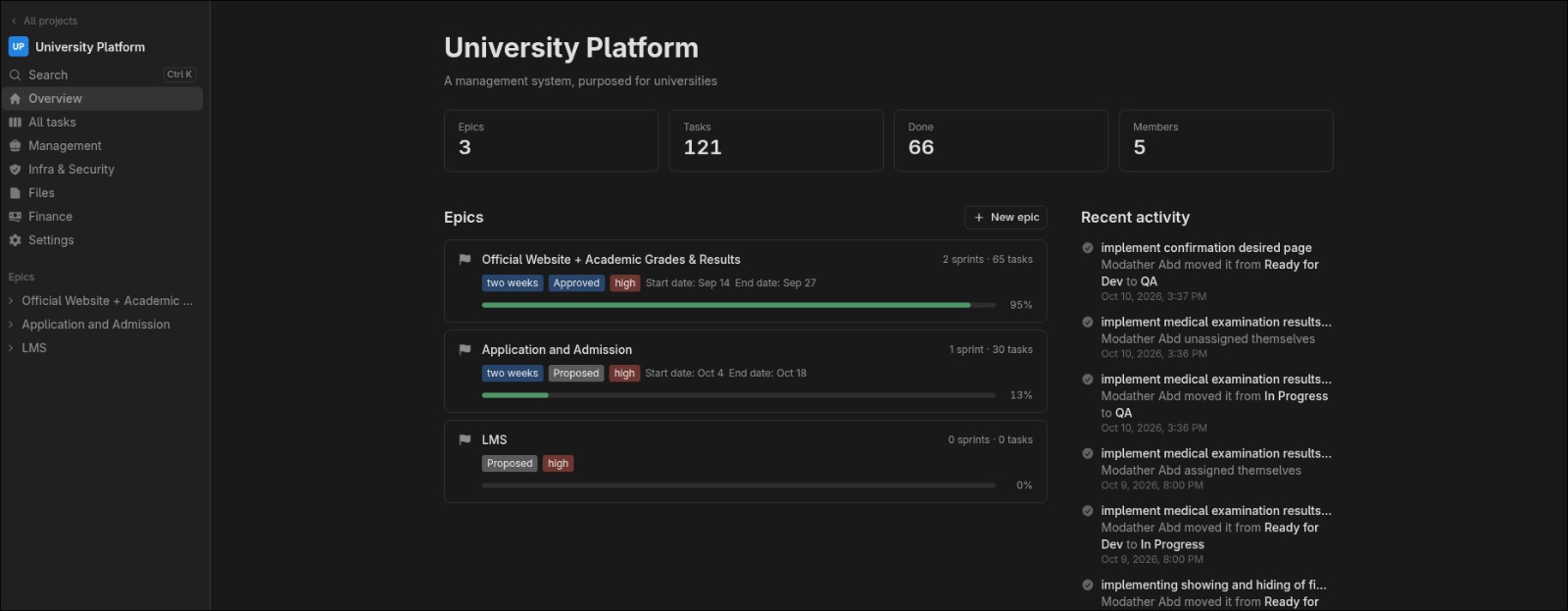
We built Agile Master, a Scrum-based project manager that we own and host ourselves:
- One structure: projects contain epics, epics contain sprints and sprints contain tasks.
- Notion-style editing on every item: custom properties and a rich-text editor with / commands.
- Jira-style boards and tables: drag and drop, grouping, filters and task keys like UNI-12.
- Automatic tracking: In Progress and QA timestamps are recorded, along with time tracked per assignee.
- Collaboration: comments with @mentions, a change history on every item, an inbox, and a shared file area for each project.
- Simple access control: Owner / Member / Viewer roles for each project.
- A Finance module: contract value, payment schedules, expenses, and team pay calculated from the weights of completed tasks and each member's experience level. Neither Notion nor Jira offers this.
It also handles Arabic and other right-to-left text correctly.
Outcome
Adding a member costs nothing, and no feature is locked behind a tier. Documentation, delivery and payment are in one system. The paywall pushed us to build exactly what our team needed, including features no subscription sold.
---
Notion's and Jira's pricing tiers change often, so I left out specific limits like user caps and storage sizes. If you want hard numbers in the piece, check the current plan pages first.